Mystery Worshipper: Cool Dude
Church:
Church of the Holy Cross, King’s Cross
Location: London, England
Date of visit: Sunday, 9 August 2026, 11:00am
The building
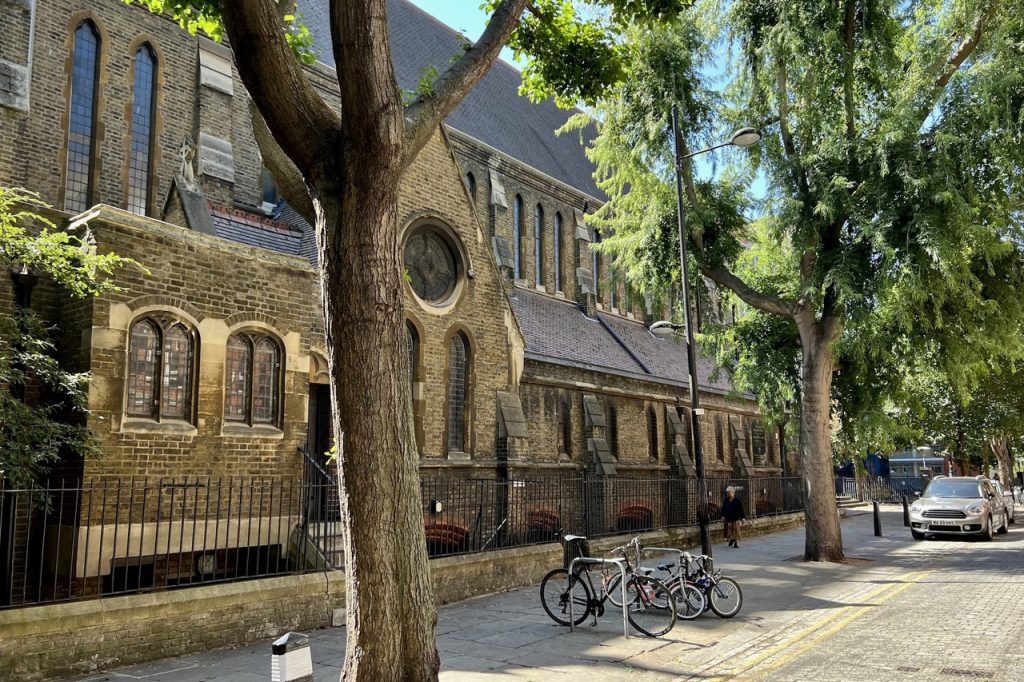
Purpose built in 1877-88 in a slum district and paid for by the Revd Alfred Moore. The architect was Joseph Peacock and the church was squashed into a compact site, originally surrounded by terraced housing. The west end is at right angles to the street and the exterior is described by one architectural historian as having ‘a quirky and aggressive style that is associated with Peacock’. Inside, the church is spacious and well-lit, but architecturally fairly plain, with the result that the eye is drawn to the many Anglo-Catholic fittings, such as a font with whacky decoration, various shrines, and stations of the cross in pietra dura and mosaic. There is a lofty rood over the entrance to the sanctuary. Whether for lack of funds or because they had the good sense to duck the latest fashions, the interior has not been modernised in recent decades; no white gloss paint over Victorian brickwork, no conference seating in place of the sturdy pine pews, no obtrusive new lighting.
The church
The excellent Holy Cross website states their ‘essential Christian mission remains the same, both as a church designed for beautiful and formal worship and as a church which exists in service of others, and particularly to those experiencing the ravages of life.’ By 1982 King’s Cross was notorious for drug-dealing and prostitution, so the English Collective of Prostitutes staged a 12 day sit-in at Holy Cross as a protest against police harassment. This attracted national media coverage. The then vicar, Fr Trevor Richardson – ‘Trev the Rev’ to the tabloid press – said that the sit-in could continue so long as it didn’t interfere with services. It did, and they didn’t. Today the crypt hosts English language classes for asylum seekers and the church is often hired as a music venue and rehearsal space. Everything is well loved and well maintained, giving the impression that this small but committed parish is a going concern.
The neighborhood
King’s Cross gave its name to the large railway terminus it hosts. Once the railway arrived in 1852, most of the middle class terraced housing became sub-divided and run down. If the buildings from that period survive today, it is as small budget hotels. Proximity to major universities, hospitals and research institutes of global reach has brought regeneration of the area as the Knowledge Quarter, encompassing genome and molecular medical research, and AI development; Google Deep Mind’s vast new laboratory is nearby. Whether this will materially affect the lives of the working people in the social housing schemes around Holy Cross church is not yet clear.
The cast
A stand-in priest celebrated – he was a student chaplain from a nearby college, since the parish is on the cusp of an interregnum – and there was an altar party of three and the organist.
What was the name of the service?
Parish Mass.How full was the building?
Mass at Holy Cross has a soft launch. When I arrived five minutes before the advertised time, there were two of us. By the end of the first hymn this had grown to 12. By the time of communion we were 22 in number. Once assembled, we were a mixed bunch in terms of age, origin and dress. I got the impression most people had come to church solo, rather than attending in couples or family groups.
Did anyone welcome you personally?
A lady behind a high pile of hymn books and service sheets welcomed me with a nice smile.
Was your pew comfortable?
A Victorian pine pew and rather gaunt in design, but for me very comfortable in the sitting. I do prefer pews to chairs as they offer something firm for steadiness during sitting and standing, and we did quite a bit of up and down in this mass.
How would you describe the pre-service atmosphere?
As described above, rather lonesome, going on anxious that there would be only two of us.
What were the exact opening words of the service?
After a few words of introduction from the stand-in priest, who gave us his name, then: ‘In the name of the Father...’
What books did the congregation use during the service?
New English Hymnal, a weekly service sheet that included all three readings and the psalm, and a service booklet for the parts in between.
What musical instruments were played?
The organ. The acoustics are very good, and the sound system (for speech) is superb. The organ, on the other hand, could do with tuning.
Did anything distract you?
Many seemed not to regard the four hymns as a participatory part of the liturgy. Perhaps a music group of three or four from the congregation, sitting together, would help.
Was the worship stiff-upper-lip, happy clappy, or what?
A modern catholic mass at a nave altar, which is as well since the high altar is at the top of eleven vertiginous steps. That also had candlesticks of record breaking height, but the nave altar was more simply dressed, and receiving communion in one large circle around it gave the service a friendly feel. The mass was sung. The Peace was very comprehensive with some personally greeting every other person in the congregation. At this level of attendance I guess that’s nice. Incense was used, though sparingly, as the thurible was acting up.
Exactly how long was the sermon?
9 minutes.
On a scale of 1-10, how good was the preacher?
7 — As a visitor, the priest started by asking us if we could all hear him. In fact we could hear every word, but it was nice to be asked and how rarely clergy think to check. His style was accessible and brisk, so he covered quite a lot of ground.
In a nutshell, what was the sermon about?
He recounted a charity project in his native South Africa where a church provided tinned food for a nearby township only to discover after a while that what the people there wanted more was a kitchen garden to grow their own traditional vegetables. The church switched to fundraising for irrigation and gardening facilities. He linked the need to listen to each other to our first reading (1 Kings 19:9-18) in which Elijah hears the voice of the Lord in the ‘sheer silence’ of a cave. He also lent on the Lord’s instruction to Elijah to anoint a foreigner king of Aram-Damascus.
Which part of the service was like being in heaven?
The feeling that Holy Cross is a church for its varied and fragile local community.
And which part was like being in... er... the other place?
Nothing hellish, but more enthusiastic hymn singing would have been nice.
What happened when you hung around after the service looking lost?
About half lingered. I chatted to two elderly East Asian ladies, who told me they lived locally to the church.
How would you describe the after-service coffee?
I was offered coffee, served in insulated paper cups, and there were small cakes.
How would you feel about making another visit (where 10 = ecstatic, 0 = terminal)?
7 — It was the middle of an oppressive heatwave and also the holiday month, so I might return another time of year in the hope of larger numbers, and more spirited hymn singing!
Did the service make you feel glad to be a Christian?
Yes.
What one thing will you remember about all this in seven days' time ?
The large circle we made for communion.