Mystery Worshipper: Portola
Church:
Evangelical Church on Paulshöhe, Boltenhagen
Location: Germany
Date of visit: Sunday, 16 August 2026, 11:00am
The building
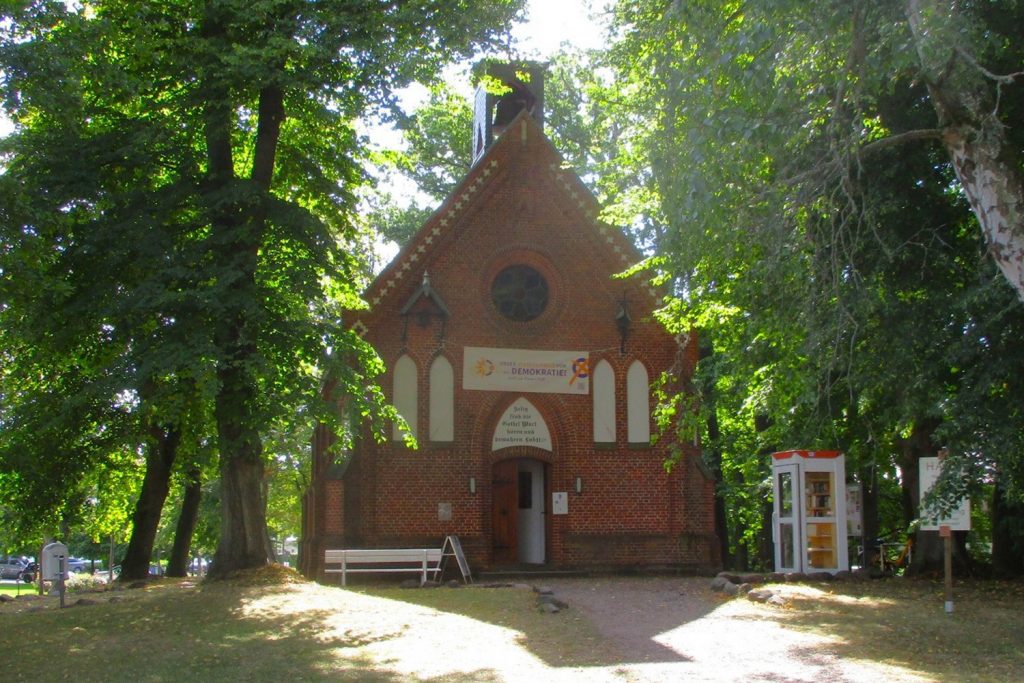
This neo-Gothic brick chapel was built in 1872 on a sand dune, which today is called Paulshöhe (Paul’s height), 200m from the beach. In that year a storm wave with a height of 3.25m assaulted the building, which was still under construction. However, the church survived and was dedicated in 1873. It has a roof turret with a motor-operated bell, and two hand-operated bells on west front gables of the church. The altar was reconstructed in 1973 so that it would be possible for the congregation to gather in a circle around the table for holy communion. In the altar area is a seven-armed menorah, a reminder of the Jewish roots of the Christian faith.
The church
Boltenhagen has been a seaside resort since 1803, and the first worship services took place in hotels. The congregation in Boltenhagen has about 450 members. In 2021 Boltenhagen was combined with the congregation in the neighboring town of Klütz. In the summer there are several options for the thousands of visitors to this seaside resort: concerts, organ music, movie evenings, a ‘travel blessing’, an evening service at 9pm on the beach, which is a five-minute walk from the church. The church is kept open every day.
The neighborhood
Boltenhagen has been documented as a town since 1325. It is the second oldest seaside health resort on the Baltic coast of Germany. For over 200 years people have come to this place for rejuvenation. It is a small city with a population of only 2,500. It offers three miles of sandy beaches, a pier 290m long, and a long wooden walking deck over the sand dunes. The area around Boltenhagen is relatively unspoiled, with open fields, forest, a trail along a coastal cliff and no big shopping centres.
The cast
A pastor presided and preached. A lay person read the Gospel and another read a prayer.
What was the name of the service?
Gottesdienst (Divine Service).How full was the building?
About 60 people, which seemed to be 90 per cent of the capacity. At seaside health resorts, church services are typically well-attended.
Did anyone welcome you personally?
A person at the door welcomed people, but she was momentarily distracted when we arrived, so we did not get a greeting.
Was your pew comfortable?
The pew was comfortable.
How would you describe the pre-service atmosphere?
The people in attendance were quiet. Directly behind us was a recess which served as an open sacristy, where two people discussed the contents of the upcoming intercessory prayer and where the pastor made a pre-service prayer with the two participating women.
What were the exact opening words of the service?
‘Good Morning, dear congregation! I greet you heartily to this service, for which we are gathered. Please take note of what I say to you: You are good! You are good! There will be an explanation in the sermon.’
What books did the congregation use during the service?
The hymn book, Evangelisches Gesangbuch für die Evangelisch-lutherische Landeskirche Mecklinburg und für die Pommersche Evangelische Kirche.
What musical instruments were played?
Organ, built by Schuke of Potsdam in 1956. It has one keyboard, pedals, five stops and 415 pipes.

Did anything distract you?
Three people entered the church during the middle of the sermon. Two of them squeezed into a pew in the middle; the third person wanted to remain standing at the back of the church, but the person responsible for greeting visitors told him to take a seat, so he went to the front of the church where a seat was available. Bodily movement during a sermon is a big distraction which momentarily affected my concentration.
Was the worship stiff-upper-lip, happy clappy, or what?
It was a traditional Lutheran service without communion, with some elements sung responsively by pastor and congregation. The pastor followed the liturgy as given, which has become unusual in the Evangelische Kirche, where pastors like to be creative and avoid the word ‘Lord’. As usual in Germany, the congregation sat most of the time – also during the hymns - standing only for the Gospel reading, the creed, the Lord’s Prayer and the closing blessing. The singing of the congregation was surprising. Instead of the timid singing to which I am accustomed, this congregation sang with good volume, even during a hymn which was not well known and not easy to sing.
Exactly how long was the sermon?
23 minutes.
On a scale of 1-10, how good was the preacher?
7 — He spoke freely without reference to any written notes or text. He occasionally rambled, and sometimes did not enunciate clearly enough. However, he spoke in a pleasant manner and his message was uplifting.
In a nutshell, what was the sermon about?
In the parable of the Pharisee and the tax collector we are confronted with images that people have of themselves. These images are produced by parents and peers; they can lead us to believe we are failures, or they can give us self-esteem. The Pharisee was conscientious about keeping the laws of the Bible, which meant that he might tend to look down upon those who were less attentive. The tax collector gained prosperity by unscrupulous methods, but he had come to recognise that he was not intact. God does not judge us on the basis of the images we have of ourselves, or that others might have of us. God says to us: You are good! Because I made you good as my creation, not because of your success or failure.
Which part of the service was like being in heaven?
On the wall of the organ loft, above and behind me, was a representation of the Apostles Creed with symbolic images designed by Rudolf Koch (1876-1934). I met the daughter of this artist at the end of her life through a remarkable chain of circumstances. Because I had done her a service and had appreciated the artwork of her father, she gave me a book containing a comprehensive collection of his Christian symbolic designs. It warmed my heart to see some of the images from this book at the back of this church and to remember the relationships I had with the delightful family members of this artist.
And which part was like being in... er... the other place?
From my seat I could see one of the information signs which had been placed on the walls of the sanctuary as part of an exhibition commemorating people who had fled the East German regime via the Baltic Sea. The sign read: ‘At least 174 people died fleeing over the Baltic Sea between 1961 (the building of the Iron Curtain) and 1989 (the fall of this barrier). We grieve for them.’
What happened when you hung around after the service looking lost?
The small number of people who felt responsible for this service were preoccupied afterwards and did not take notice of anyone looking lost or sitting alone at the back of the church. Several people went to the front of the church to light a prayer candle. Others went to the sides of the church to read the exhibition signs on the walls. There was no focal point for visitors to be noticed or addressed.
How would you describe the after-service coffee?
No coffee or tea.
How would you feel about making another visit (where 10 = ecstatic, 0 = terminal)?
8 — The sanctuary of this chapel-sized church has a cosy and warm atmosphere.
Did the service make you feel glad to be a Christian?
Yes.
What one thing will you remember about all this in seven days' time ?
Despite the warning of Jesus in the Sermon on the Mount not to build on sand, this church was built on a sand dune and endured one of the most violent storms of the 19th century. A massive tidal wave destroyed farm houses and hostels, forcing people to climb to the roof-tops to survive. Miraculously, no one was killed. And this church, which was under construction and which had been invaded by sea water, remained standing and was consecrated one year later.