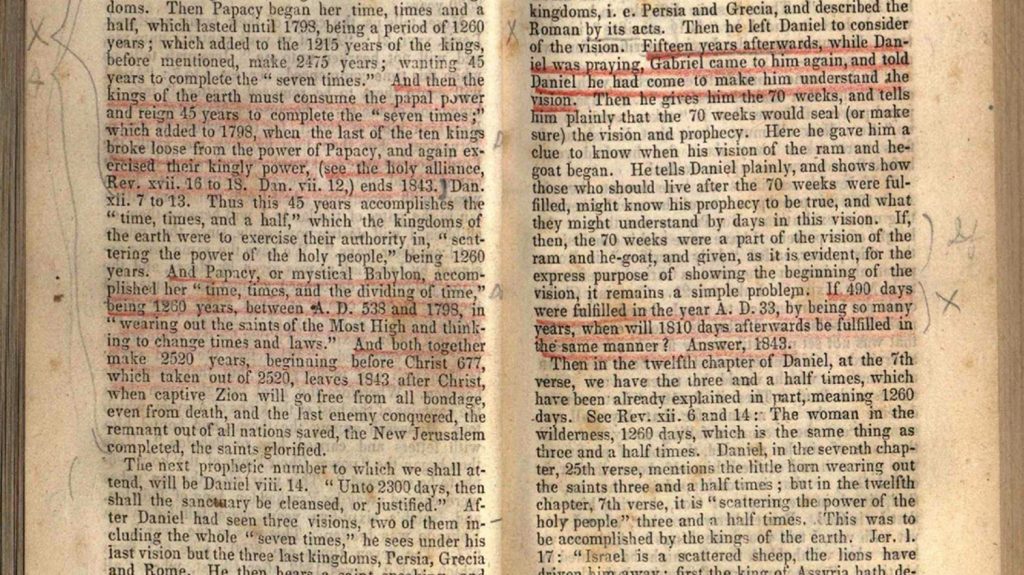
Spare a thought for the thousands of people who lived through the Great Disappointment today in 1844. The New England preacher William Miller announced the world would end in 1844 at the latest, based on verses in the Book of Daniel. He predicted Christ would return by 21 March, but when that date came and went, a new date of 18 April was set, which also passed. Somehow, a third date of 22 October caught the public imagination in the northeastern United States, with Millerite newspapers, books (e.g. above) and tracts hyping the end of the world. In the final 10 days, believers gave up their jobs to prepare for the apocalypse, with rumours that some made themselves ‘ascension robes’. When nothing happened, the loss of faith was so great that what was left of the Millerite movement fractured, leading to the eventual formation of the Seventh Day Adventists and the Jehovah’s Witnesses.
‘I confess my error, and acknowledge my disappointment; yet I still believe that the day of the Lord is near, even at the door; and I exhort you, my brethren, to be watchful, and not let that day come upon you unawares. The wicked, the proud, and the bigot, will exult over us. I will try to be patient.’ William Miller, May 1844
Today is the feast day of Salome, who was among the small group of women at the crucifixion, and who carried spices to anoint Jesus’ body at the tomb on Easter morning. It is likely that her sons were the disciples James and John, and that her nephew was Jesus.
New saint Pope St John Paul II has his feast day today. The date was chosen to mark the anniversary of his inauguration as Universal Pastor of the Church in St Peter’s Square, Rome, in 1978. During the ceremony he was not crowned as Popes had been for centuries, because his predecessor, John Paul I, had renounced such ostentation.
The oldest known printed document bearing an actual date was issued today in 1454. It was an indulgence by Pope Nicholas V, and once you had paid for it, and your name and the date had been entered into the blank spaces, you could take it to your priest to show your sins could be pardoned without having to do penance. The indulgence was printed by Johannes Guterberg in Mainz, using his invention of moveable type, and it was part of a new mass production of indulgences in the decades leading to the Protestant Reformation.
Today is the feast day of the Seven Sleepers of Ephesus in the Eastern Orthodox Church. According to legend, seven young men escaped the persecution of Christians in the time of the Roman Emperor Decius by hiding in a cave. The cave was sealed with rocks, and then forgotten. It was was only rediscovered three centuries later by a farmer, and when the rocks were cleared, the seven young men came out, thinking they had only slept for a single night. The story, with its theological theme of death as a sleep which ends in resurrection, found its way into the Qu’ran, where the sleepers were accompanied by a dog, who guarded the cave and its sleepers.
‘I thought I had slept with my brothers for but a single night; but as I now find out, the heavens have passed a great many years above our slumber. And now has the Lord ordained me with my brethren so he may teach every generation, because the re-arising of the dead has come to be. Therefore follow me and I will show my brothers to you, who have been resurrected with me.’ The Seven Sleepers of Ephesus, told by Gregory of Tours (translated by Michael Valerie)
The Definition of Chalcedon was passed on this day in the year 451. The main business of the Council which produced it was to unite the Church around an agreement of who and what Jesus is (fully God and fully human) with some highly technical Greek theology cementing it all together. Unfortunately the cement came apart straight away, splitting the Church east and west. The Oriental Orthodox Churches in Syria, Armenia, Egypt, Ethiopia and India have never accepted the Definition of Chalcedon.
‘This one and the same Christ, Son, Lord, Only-begotten, is made known in two natures without confusion, without change, without division, without separation. The distinction of the natures is in no way taken away by their union, but rather the distinctive properties of each nature are preserved.’ The Definition of Chalcedon
Image: Internet Archive