Mystery Worshipper: Cool Dude
Church:
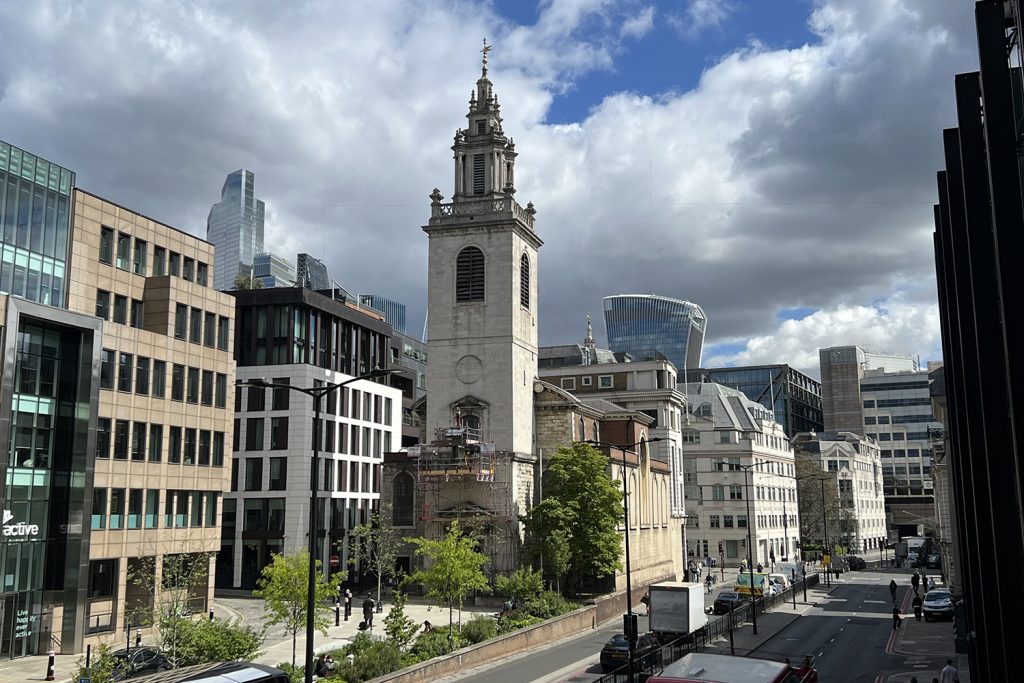
St James Garlickhythe, Garlicke Hill
Location: London, England
Date of visit: Sunday, 19 April 2026, 10:30am
The building
Built by Sir Christopher Wren after the Great Fire of London, this is the third structure on the site. Miraculously it survived the Blitz in World War II almost unscathed; a bomb did fall through the roof but was a dud and failed to explode. Three decades ago, a crane constructing a nearby office building collapsed and fell through the roof. This assault too has been repaired. It is not a large church but has many historic fittings and a pretty tower with stages of diminishing size.
The church
The congregation almost certainly travel into the city centre to worship here. Several livery companies (ancient guilds) have associations with the church because their ceremonial halls are nearby. A number of people at this service appeared to be holding wands of office associated with the livery companies. St James appears to have attracted a settled congregation in spite of its distance from residential areas. A group of them were to walk a mini-pilgrimage from Whitstable to Canterbury cathedral for Evensong the following week. The main services from St James are live-streamed.
The neighborhood
For centuries, the area around the church was teeming with residents and trading premises, but today it is filled with offices, and is deserted at weekends. The small number of residential flats seem to be used as small pieds-à-terre, occupied only on weekdays; likewise the super-discreet boutique hotel next door to the church. The narrow streets round about carry little traffic, so it is surprisingly peaceful for such a central location. Except, that is, for the four lane highway immediately to the south, of which one is surprisingly unaware once inside the church because all the windows on that elevation are blocked up.
The cast
The rector conducted the service and preached, assisted by two servers. A robed third person (possibly a churchwarden) sat to one side of the altar throughout, and there was a choir and organist.
What was the name of the service?
Sung Eucharist.How full was the building?
About 35 plus a volunteer choir at the west end of 15 or so, with a good spread of ages.
Did anyone welcome you personally?
A gent on welcoming duty gave me a friendly hello and the paperwork. In response to my query about where to sit he replied that the front row would be a bit conspicuous. I was in agreement with that, so selected the second row.
Was your pew comfortable?
It was a proper church pew with a cushion, so nice and firm for the standing and comfortable for the sitting bits. There was a chunky leather kneeler but I am not sure many knelt, opting instead for the Anglican stoop.
How would you describe the pre-service atmosphere?
The organist tried to set a contemplative tone by playing quietly, but the congregation seemed intent on lively chatter. At one point the organ had to compete with phrases of different music altogether being played on a grand piano at the back. Then suddenly – presumably on a sign that I missed – all fell silent.
What were the exact opening words of the service?
‘Our Father, which are in heaven…’ The Lord’s prayer recited almost privately by the priest alone at the altar.
What books did the congregation use during the service?
The Order of Service booklet, a sheet of readings for the day, and what was described as a blue hymnbook. This was the English Hymnal (and green).
What musical instruments were played?
An organ for the hymns and a piano to accompany the choir for the musical parts of the eucharist. According to the church website the choir are volunteers, and they were very good. The organ was originally built in 1697 by Bernard Schmidt, who though German is celebrated as a key figure in the invention of the English school of organ building. It has been restored and rebuilt umpteen times since. The sung parts of the eucharist were a setting by Rheinberger and there was a Stanford motet.
Did anything distract you?
Being unable to find the first hymn in the book. I wondered if everyone else was indeed singing from a blue book, not a green one, then realised the wrong numbers had been put on the hymn-board – and this was later corrected with an announcement.
Was the worship stiff-upper-lip, happy clappy, or what?
Old school high church using the Book of Common Prayer (BCP). I am sufficiently familiar with the BCP’s beautiful 17th century way of saying things for this not be a barrier. But there were one or two variations from what I am used to. For example, the prayer of humble access was said before the consecration rather than as the congregation’s response to the invitation to communion, where I am used to it, and where it seems to me to make better sense. The sermon did not immediately follow the reading of the Gospel. After the consecration, the rector adopted a crucifixion stance – his arms held outstretched at full extent silently for several seconds. This was bold and striking. The final blessing he pronounced standing sideways to both the altar and the congregation, turning his head to look at us over his right shoulder. I was unclear of the intended meaning of what was clearly a deliberate gesture, since he seemed to be making the sign of the cross to a blank wall. Services according to the BCP have been a feature of worship at St James for many years.
Exactly how long was the sermon?
12 minutes.
On a scale of 1-10, how good was the preacher?
7 — He preached from the 17th century pulpit, so from some height, and was clear and accessible and direct. Whether because of the huge tester (sounding board) above his head or modern electronics, I know not, but every word was clear.
In a nutshell, what was the sermon about?
It was Good Shepherd Sunday, so called because the Gospel reading (John 10:11-16) begins, ‘Jesus said I am the good shepherd: the good shepherd giveth his life for the sheep.’ He therefore offered thoughts on his role as leader of a worshipping community and the lay leadership of this, or any, Christian community. Leadership can be lonely and unrewarding if people put others’ interests first as they should; leadership is a servant role.
Which part of the service was like being in heaven?
The glorious sunshine pouring in through the large windows glazed with clear glass. And a babe in arms who was carried by his father to the altar rail at communion and who looked around, fascinated at what was going on around him.
And which part was like being in... er... the other place?
Being ignored after the service.
What happened when you hung around after the service looking lost?
The parochial annual meeting was due to take place after the service but we were nevertheless invited to drinks at the back of the church, before business started. Most people seemed to stay – maybe the annual meeting was expected to be entertaining, which would have been a first. I got the impression it was a social parish community. But in spite of hovering in the aisle, then at the back, and doing my best to appear both lost and approachable, as Mystery Worshippers are instructed to do, neither congregation nor clergy spoke a word to me. So I headed home instead to write this.
How would you describe the after-service coffee?
This seemed to come from a filter machine but I didn’t sample it. A tray of proper coffee mugs was carried in and two trays full of red and white win in glasses. Conviviality beckoned.
How would you feel about making another visit (where 10 = ecstatic, 0 = terminal)?
6 — Its not too far from where I live, so I may be tempted to skive off my parish and make the occasional visit.
Did the service make you feel glad to be a Christian?
Yes.
What one thing will you remember about all this in seven days' time ?
The priest’s crucifixion gesture after the consecration.